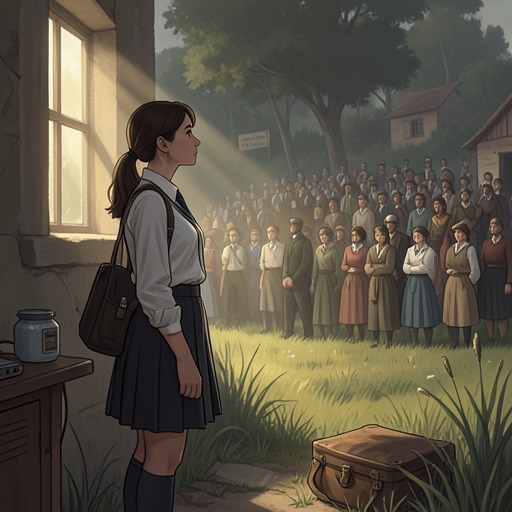
Senior year of high school
Always and Forever, Lara JeanSenior year of high school is the final year before Lara Jean leaves home for college, and the book gives its ending a double rhythm: the ordinary routines of school continue even as the people around her begin to move toward different futures. Its decisive significance lies in making adulthood less a single graduation-day threshold than a series of choices, farewells, and family rituals that do not happen on the same schedule for everyone.
A year of competing paths
The year’s future is not a uniform plan shared by Lara Jean and her friends. Chris intends to take a year off, work on farms in Costa Rica, and accept room and board in exchange for labor. She also imagines other possibilities, including teaching surfing in New Zealand or learning to make wine in Italy. Her enthusiasm for going somewhere without a settled career or college plan contrasts with Lara Jean’s attention to admissions and the route ahead.
Lara Jean’s own plans become less certain when she does not get the outcome she wanted at the University of Virginia. Peter imagines a route back to UVA: he points to Toney Lewis, who transferred there after two years at PVCC, and suggests that Lara Jean could attend another four-year college first and apply to transfer. The plan lets him picture them at UVA together, but Lara Jean is still adjusting to the fact that she will not begin there. Their different responses mark the gap between a hopeful possibility and a decision already altered by circumstances.
Margot offers a different kind of guidance. She tells Lara Jean to make friends of her own rather than rely on Peter’s lacrosse connections, and to find people who suit her at a large university. Margot also urges her to join an Asian association, recalling that studying in a different country left her feeling she had missed out on an Asian-American group and on the experience of exploring racial identity in college. Her advice treats the transition not only as a move to a new school, but as an opportunity to build community deliberately.
Learning to leave and let others choose
College is not the only measure of readiness in the family. As Lara Jean helps Dan and Trina plan their wedding, Trina gently asks her not to turn the preparations into another responsibility to manage. The couple do not need elaborate details such as a food truck or miniature banana puddings; they would be happy with barbecue from BBQ Exchange. Trina wants Lara Jean to enjoy her one senior year, her new college prospects, her coming birthday, and the time she has with Peter. Lara Jean replies that organizing the wedding calms her, revealing how the work is also a way she copes with change.
Dan, meanwhile, finds the prospect of Lara Jean’s independence harder to accept. When she is going to Beach Week with no adult supervision, Trina reminds him that Lara Jean is not a child and will soon be living on her own. Dan acknowledges that Trina is right without pretending he likes it. Trina then gives Lara Jean practical advice for Beach Week and college: keep a buddy system, taking turns so one friend remains sober enough to care for the other. The exchange makes independence concrete: it brings new freedom, but also requires people to look after one another.
The differences in timing extend to Chris. When Chris wonders whether she might be missing out by not going to college when everyone else does, Lara Jean tells her that college will still be there next year or later, whenever she wants it. Chris can picture Lara Jean at the University of North Carolina, while Lara Jean explains her own current plan: William & Mary for a year, then UVA. The conversation holds two futures side by side without resolving them into one correct timetable.
The closing rituals of school
As the year runs out, time itself seems to change pace. In the final stretch, teachers wear shorts and T-shirts, show movies while cleaning out their desks, and move through classes with little energy left. Finals go well, even calculus, but success does not restore the possibility of another school year. Lara Jean describes life as feeling fast and slow at once: the present is still happening, yet it already seems to be receding.
With only three days of school left, the yearbooks arrive. Lara Jean has saved the back cover for Peter because she does not want to forget how special the year has been. The yearbook turns the end of school into something that can be signed and kept, while its blank pages point toward relationships and memories that will continue beyond the building. On the last day, she and Peter walk up the staircase together for the last time, Peter taking the stairs two at a time as Lara Jean hurries after him. The familiar gesture becomes newly legible because it is also a farewell to a daily routine.
Graduation makes that threshold public. Before the ceremony, Lara Jean smooths her dress and checks that her cap is in her bag; her family rides together while Dan goes separately to pick up Grandma. Lara Jean thinks of her mother, who cannot be there for this milestone or the others to come, and wishes she could receive a hug from her. She also looks for Peter’s family among the crowd. Her own family is easy to spot: they wave whenever she looks over, and Trina wears a broad Kentucky Derby hat that Lara Jean likes despite Kitty’s judgment that it is a bit much.
When the principal calls her name, he pronounces Lara as Laura. Accepting her diploma, Lara Jean quietly corrects him: it is Lara, not Laura. In the brief correction, the ceremony’s formal recognition of her achievement meets her insistence on being named accurately. Graduation marks a passage into adulthood, but it does not make her identity or her family history disappear.
Family milestones and remembered ties
The year’s movement toward adulthood is accompanied by a widening family. At graduation, Dan surprises the sisters by sending them to Korea with Grandma the following month. The trip had been discussed for years, and their mother had wanted to take them; the gift therefore carries both excitement about travel and a connection to a family wish that predates this new arrangement. Trina and Dan are to take their honeymoon while the three girls go with Grandma.
Trina and Dan’s wedding later gathers that changing family into a small backyard ceremony. Christmas lights and white paper lanterns decorate the yard, and the guest list is under fifty. The sisters take their places as “Lullaby” begins, while Dan stands on the groom’s side and Trina walks toward them. They cry during the traditional vows; when Reverend Choi tells Dan he may kiss the bride, Dan turns beet red before kissing her with a flourish. Kitty whoops, the guests applaud, and Jamie Fox-Pickle barks. The scene gives the girls a place in the ceremony not as spectators to their father’s new marriage, but as participants in the family it forms.
Trina has also made the father-daughter dance an occasion for the three sisters. Since she has already had her own turn, she says it will mean more for the girls to dance with Dan. They have practiced on the rented dance floor, and the sequence is planned to begin with Margot, then Lara Jean, then Kitty cutting in. Dan chooses “Isn’t She Lovely,” Stevie Wonder’s song for his newborn daughter. The order and the handoffs turn a familiar wedding tradition into a shared expression of the sisters’ separate places in their father’s life.
The last summer before departure
The approaching departure is felt in smaller, private choices as well as ceremonies. On prom night, Lara Jean puts on Stormy’s ring in honor of Stormy and all the dances she attended, bringing an absent friend into a milestone that belongs to the present. The object links the newness of prom to remembered affection rather than allowing the occasion to stand alone.
The night before Lara Jean leaves for college, Peter plans to watch the Perseids meteor shower with her at the lake. Kitty longs to come too but does not ask; Lara Jean usually would have said yes, but this time she keeps the evening for herself and Peter. Kitty’s disappointment shows for a moment before she hides it. In the car, Lara Jean feels guilty for being possessive of the little time left and thinks that Margot would have brought Kitty. The moment refuses an easy version of growing up: leaving home means claiming new intimacies, but those choices can hurt the people who remain. Senior year ends not with every attachment neatly settled, but with Lara Jean beginning to understand that love and separation will have to coexist.